What Is a Perpetual Futures Contract?
A perpetual future — or “perp” — is a derivative contract that tracks an asset’s price with no expiry date. You can hold a position for minutes, days, or months, and a periodic funding payment between longs and shorts keeps the contract price tethered to the underlying spot market.
Visual evidence and OCR reference
BULK Exchange perpetuals explainer
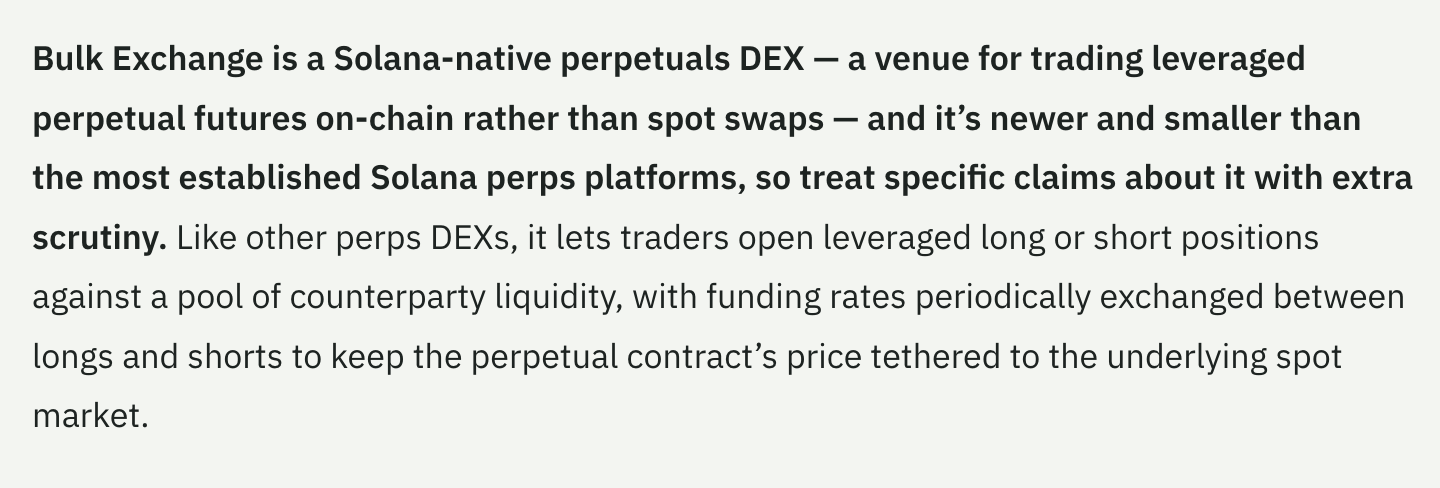
This visual reference frames BULK as a Solana-native perpetuals venue and distinguishes leveraged perpetual futures from spot swaps. The surrounding guide explains the contract mechanics in plain English.
Perps vs. dated futures vs. spot
Buying spot means owning the asset. A perpetual contract is a bet on price direction settled against an index of the spot market — you can go long or short, use leverage, and never take delivery of the coin.
Dated futures (the kind on traditional exchanges) expire on a set date, which forces rolling positions and creates predictable price distortions near expiry. Perpetuals remove the expiry entirely: open a position, manage your risk, and close whenever you want.
What keeps a perpetual tethered to spot
Without an expiry to anchor price, a perp needs another mechanism to stay near the underlying index: funding. When the perpetual trades above spot, longs pay shorts a periodic funding fee; when it trades below spot, shorts pay longs.
That payment incentivizes traders to trade against the deviation, which is what pulls the contract back toward the index. On BULK, funding settles hourly.
Leverage, margin and liquidation
Perps let you control a position larger than your collateral through leverage. That amplifies both gains and losses, so the exchange continuously marks your position to the current price and liquidates you if your margin drops below the maintenance requirement.
Exchanges differ in how they treat your whole book. BULK uses true portfolio margining, where every position hedges and offsets the others, so margin requirements are calculated across the entire account rather than per-market in isolation.
- Long: you profit when price rises. Short: you profit when price falls.
- Mark price (derived from the index) is used for liquidations, not the last traded print, to reduce manipulation.
- A liquidation cascade can happen when many leveraged positions are forced to close at once — watch open interest and funding for early warning signs.
Why traders use perpetuals
Perps are the most capital-efficient way to express a directional view on crypto: no expiry to manage, both directions available, and leverage that lets small accounts size like large ones. They also dominate liquidity — the deepest books in crypto are perpetual order books, not spot.
Because all orders on BULK execute on one deterministic order book at the same best bid and offer, perp traders get exchange-grade execution without the conflicts of internalized venues.
Track these markets
Put the concepts to work on live order flow. Each market below links straight to its live view on BULK with referral attribution already applied.
Open Bulk.Trade through the market link.
The market link includes referral attribution automatically — no code to copy, no box to find, and no extra form to fill.
- Click the market button below — referral attribution is already in the link.
- Connect your wallet and create your Bulk.Trade account.
- Trade. The referral is attached automatically — nothing else to do.
Referral rewards are paid weekly from BULK's dedicated AURA pool per docs.bulk.trade. Boost and referral terms are set by BULK and may change.
Frequently asked questions
Can you hold a perpetual future forever?
Yes — perps have no expiry date. You can keep a position open as long as your margin remains above the maintenance requirement and you pay (or receive) funding each period.
What is the difference between a future and a perpetual future?
A dated future expires on a set date and must be rolled or settled; a perpetual future has no expiry and instead uses periodic funding payments to track the spot price.
How much can you lose trading a perpetual?
You can lose the margin on your position. With leverage, a small adverse move can wipe out your allocated margin before the exchange liquidates you at the mark price — with portfolio margin, offsetting positions can reduce what is at risk, but leverage always cuts both ways.
What is portfolio margin and why does it matter on BULK?
Portfolio margin prices a trader’s whole account together rather than each position in isolation, so hedged positions share margin and lower the total requirement. BULK’s correlation-aware risk engine does this on-chain and reports up to ~70% capital savings versus isolated margin on hedged books.
Do perpetuals let you short the market?
Yes — that is a core advantage. You open a short by selling a perpetual you do not own, and you profit if the asset falls. Perps give traders long and short access to the same market without needing to borrow the underlying asset.
How do I start trading perpetuals on BULK?
Perpetual markets such as BTC-USD and ETH-USD are available through the linked BULK trading interface. Opening your account through a market link applies referral attribution automatically - nothing to copy, nothing to type.
Perps & architecture research
Independent explainers of perpetual contracts and the venue that anchors this site's data.
- What is BULK Exchange? — How a matching engine embeds inside Solana validators.
- BULK architecture — BULKBFT, matching engine and settlement.
- Best Solana perp DEX 2026 — BULK vs the Solana field, ranked.
- What is BULK Exchange? (YetiScan) — On-chain CLOB, BULKBFT consensus, portfolio margining and order types, plus the live terminal.
BuiltOnBulk and YetiScan are independent sites, not BULK Exchange or this network. Technical claims on BuiltOnBulk are verified against BULK's official docs (docs.bulk.trade); YetiScan is a live trade/liquidation terminal sourced from BULK's public API and WebSocket feeds.
Keep reading
- How to get BULK access
- BULK AURA points & airdrop guide
- Funding Rate Explained: How Perps Stay Tethered to Spot
- Open Interest Explained: Reading Leverage and Liquidation Risk
- Order Flow Trading Explained: Reading Aggression and Liquidity
- Glossary of perp trading terms
AURA scenario estimator
What could your AURA be worth?
Explore illustrative token-value scenarios by changing your points, the community allocation, fully diluted valuation (FDV), and total AURA supply. This is a calculator, not a forecast or financial advice.
Estimated value at selected FDV
$1,25030% × $500M ÷ 60M AURA = $2.5000 per AURA
| FDV | Price / AURA | Your value | Vs. current |
|---|---|---|---|
| $100M | $0.5000 | $250 | — |
| $250M | $1.2500 | $625 | — |
| $500M | $2.5000 | $1,250 | — |
| $750M | $3.7500 | $1,875 | — |
| $1B | $5.0000 | $2,500 | — |
| $2B | $10.0000 | $5,000 | — |